Master Bodywork Class
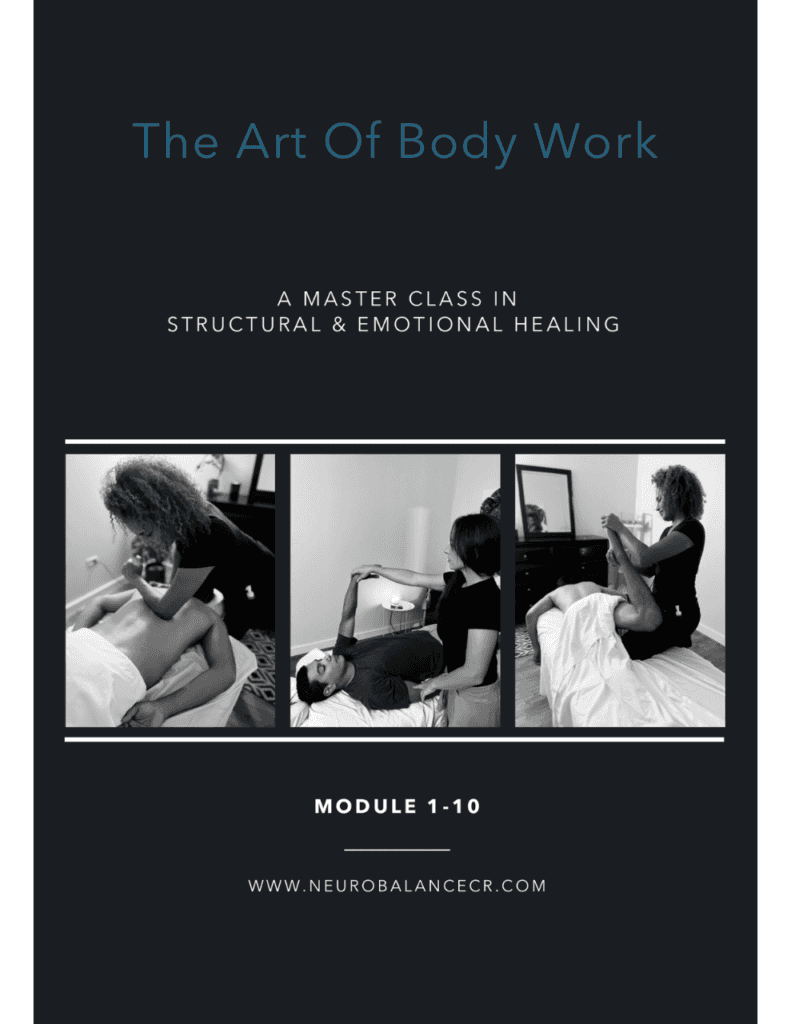
The art of body work master Class Summary
10 modules - 144 hours - $3600
Course Overview:
In this master class, you’ll learn how the structural body, nervous system, and emotional patterns are all deeply connected — and how addressing them together creates lasting change. You’ll discover why pain and dysfunction are rarely just physical problems, and how unresolved stress, poor movement patterns, and muscle imbalances can lock the body into cycles of compensation and discomfort. I’ll show you the exact framework I use to release these patterns, restore balance, and support the body’s natural ability to heal — not just physically, but emotionally and biochemically as well. Whether you’re a practitioner or simply want to understand your body better, you’ll walk away with practical tools and a new understanding of how true structural healing happens from the inside out.
Module 1 – Understanding the Body Holistically
The mind-body connection, touch, and structural assessment.
Explore how physical, emotional, mental, and energetic factors influence the body. Learn to approach bodywork from a holistic perspective, develop awareness through touch, and understand how intention and practitioner presence influence a session. We also introduce postural assessment, the body’s major structural foundations, and how to identify the body’s primary areas of imbalance.
Module 2 – Spinal Alignment & Neurological Foundations
Working with the spine and its supporting structures.
Learn techniques for assessing and releasing restrictions in the spine without forceful manipulation. This module focuses on the Atlas, occiput, sacrum, and dura, exploring their relationship to overall structural alignment. Participants learn how to use muscle testing, gentle manual techniques, breathing, and visualization to facilitate structural releases.
Module 3 – Pelvis, Jaw & Cranial Release
Understanding the body’s central structures and their relationships.
Explore the anatomy and biomechanics of the pelvis, jaw, and cranium and how they influence posture, stability, and movement. Learn practical techniques for assessing and releasing pelvic restrictions, working with key supporting muscles such as the psoas and quadratus lumborum, and addressing tension in the jaw and cranial structures.
Module 4 – Hips, Clavicles & Shoulders
Restoring mobility and balance in the upper and lower body.
Learn hands-on techniques for assessing and releasing the hips, clavicles, and shoulder structures. Explore how restrictions in these areas can influence movement and contribute to compensatory patterns throughout the body. Practical techniques focus on improving joint mobility and restoring structural balance.
Module 5 – Muscle Therapy & Scar Tissue
Working with muscles, adhesions, and restricted soft tissue.
Develop a deeper understanding of muscle tissue, fascia, and scar tissue, and how injuries and adhesions can affect movement and contribute to discomfort. Learn practical manual therapy techniques including trigger point therapy, pin and stretch, deep muscle release, and muscle stripping to address tension and restricted movement.
Module 6 – Fascia & Fascial Chains
Understanding the body’s connective tissue network.
Explore the role of fascia in structural support, posture, movement, and the transmission of tension throughout the body. Learn about the major fascial chains and how restrictions in one area can influence seemingly unrelated parts of the body. Practice techniques for assessing and releasing fascial restrictions while developing a more sensitive approach to working with connective tissue.
Module 7 – Rib Cage & Diaphragm Release
Breathing, mobility, and the body’s central support system.
Explore the relationship between the rib cage, thoracic spine, diaphragm, and surrounding structures. Learn practical techniques for assessing and releasing the first rib, thoracic spine, and rib cage, as well as working with the diaphragm and abdominal fascia. Understand how restrictions in these areas can influence breathing, posture, and overall mobility.
Module 8 – Hands, Feet, Elbows & Knees
Addressing common areas of joint pain and restricted movement.
Learn targeted techniques for working with the smaller joints and supporting muscles of the body. This module covers hands and wrists, feet and ankles, elbows, and knees. Participants practice muscle release, trigger point work, joint mobilization, and patellar mobility techniques to address common movement restrictions and areas of discomfort.
Module 9 – Working with the Emotional Body
Understanding the connection between emotional patterns and physical tension.
Explore how emotional stress and unresolved experiences can influence the body’s physical and structural patterns. Learn to recognize when emotional factors may be contributing to persistent tension or discomfort and how to incorporate energetic balancing techniques into bodywork. This module introduces emotional center testing, affirmations, Five Element balancing, color and visualization techniques, and the Emotion Code.
Module 10 – Integrating the Work
Developing a complete, personalized bodywork session.
Bring everything together by learning how to combine structural assessment, manual therapy, muscle and fascial release, and emotional balancing into a fluid and individualized session. Practice client consultations, postural evaluations, treatment planning, and full hands-on sessions. We also explore professional conduct, client communication, informed consent, boundaries, and ethical responsibilities when working with clients.
The Learning Experience
This is a practical, hands-on masterclass. Each module combines foundational knowledge, demonstrations, and partner practice, allowing participants to develop confidence and familiarity with the techniques as they progress.
The goal is not simply to learn a collection of corrections, but to develop the ability to observe, assess, and understand the body as an interconnected system — choosing the appropriate techniques according to the individual and their needs.
Prerequisites
Basic anatomy of the muscular and skeletal system.